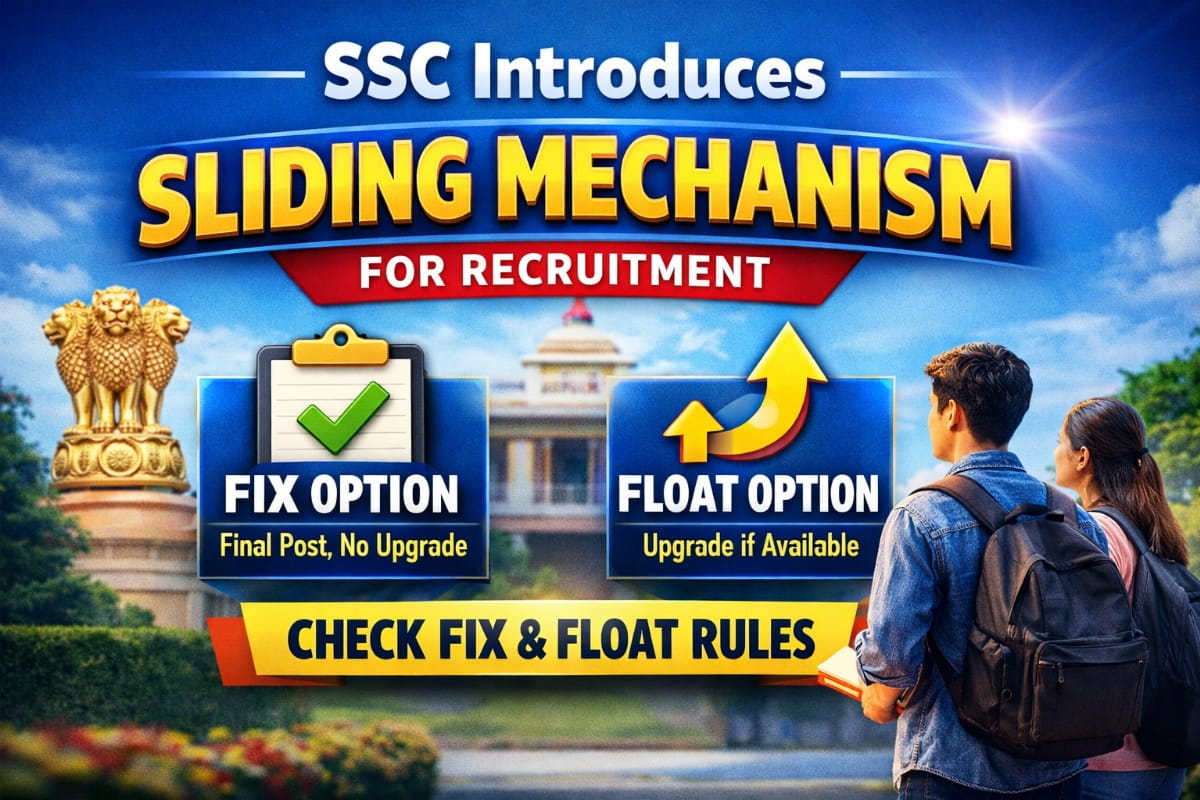
SSC Introduces Sliding Mechanism for Aspirants to improve the recruitment process. This change was announced on 03 March 2026. The main goal is to fill more vacancies in the same recruitment cycle.
Every year, many posts remain empty. This happens because some selected candidates do not attend document verification or do not join the job after selection. Because SSC does not keep a waiting list in multi-stage exams, those vacancies remain unfilled and are carried forward to the next exam.
To solve this problem, SSC has introduced the Sliding Mechanism for post allocation. This system will allow a one-time reallocation of posts so that more vacancies can be filled.
Why SSC Introduces Sliding Mechanism for Aspirants
The new system is designed to make recruitment more efficient.
Main Reasons
- Many candidates do not attend Identity Verification (IV).
- Some candidates do not join the job after final selection.
- SSC cannot maintain a waiting list in multi-factor exams.
- Vacancies must be carried forward to the next recruitment cycle.
The sliding mechanism will help SSC fill maximum vacancies within the same exam cycle.
How the SSC Sliding Mechanism Works
The process will happen in two stages.
First Round of Tentative Allocation (FRTA)
In the first step, SSC will allocate posts to candidates based on:
- Merit
- Preferences filled by candidates
This allocation will be called the First Round of Tentative Allocation (FRTA).
However, this allocation will not be final until the candidate completes Identity Verification.
Identity Verification (IV) Process
Candidates selected in FRTA must visit the SSC Regional Director (RD) office for verification.
During this process:
- Aadhaar authentication will be done
- Candidates must choose either FIX or FLOAT option
Options Available to Candidates
| Option | Meaning |
|---|---|
| FIX | Candidate accepts the allotted post as final. No upgrade will be allowed. |
| FLOAT | Candidate allows SSC to upgrade the post if a higher preference vacancy becomes available. |
This step is very important because it decides whether a candidate can get an upgraded post later.
What Happens If a Candidate Chooses FIX
If a candidate selects the FIX option, it means:
- The candidate accepts the current post as final.
- The candidate will not be considered for any upgrade.
- If the candidate does not join, the vacancy will go to the next recruitment cycle.
This option is suitable for candidates who are satisfied with their allotted post.
What Happens If a Candidate Chooses FLOAT
If a candidate selects the FLOAT option, it means:
- The candidate is ready for post upgradation.
- SSC may allocate a higher preference post if a vacancy becomes available.
Important rule:
- If the candidate gets an upgraded post, they must join it.
- If they do not join, both the old and new posts will be cancelled.
Sliding Round for Vacancies
After Identity Verification, SSC will check for vacancies created due to absent candidates.
These vacancies will be used for a single sliding round.
Key Rules of Sliding Round
- Only one sliding round will happen.
- Only FLOAT candidates will be considered.
- Allocation will be based on merit and preference.
- No waiting list will be created.
After this process, SSC will publish an updated final result.
Identity Verification Time Limit
SSC will give candidates about 10 days to complete Identity Verification.
Important Points
- Candidates must visit the SSC Regional Office.
- Aadhaar authentication will be required.
- Candidates must choose FIX or FLOAT.
If a candidate does not appear during this period, they will be marked absent and will not be considered further.
Final Result and Appointment Process
After the sliding round:
- SSC will publish the final result.
- Revised post allocation will be issued.
- Candidate e-dossiers will be sent to departments.
- Departments will complete document verification and appointment formalities.
This final result will be binding on all candidates and departments.
Conclusion
The SSC Sliding Mechanism is a candidate-friendly step introduced to improve the recruitment system. It allows a one-time post reallocation so that more vacancies can be filled within the same exam cycle.
With the FIX and FLOAT options, candidates now have more flexibility in post allocation. At the same time, SSC can reduce the number of unfilled vacancies and make the recruitment process faster and more efficient.
Related Articles
- JPSC Drug Inspector Recruitment 2026
- Rail Wheel Factory Apprentice 2025-26
- OSSSC Combined Higher Secondary Exam 2026
- RRB Group D CEN 09/2025 Update: 22,195 Vacancies
- JKSSB Staff Nurse Recruitment 2026
- AIIMS Nursing Officer Recruitment 2026
- Central Bank of India Specialist Officer Vacancy 2026
- Haldia Dock Complex Dock Pilot Recruitment
- WBPSC Librarian Recruitment 2026
- DSCE Non Teaching Recruitment 2026
- Jharkhand Civil Services Exam 2026 Last Date Extended
Editor’s Note:
Written by Karmabandhan Editorial Team.
We encourage all aspirants to verify information from official sources and apply carefully.
Disclaimer: This is not an official government website. Candidates must verify details from the official notification.

I am Surojit Koiri, a professional content writer and digital publisher with over 5 years of experience in government job updates, recruitment analysis, and exam-related news. I am the chief editor of Karmabandhan.com, a dedicated platform that provides accurate and easy-to-understand information for job aspirants across India.
